Will Bosworth

Tag: writing

Would quit again, 5 out of 5 stars

Four years ago, my wife and kids went camping to close out the summer. I had an eye infection and thought it would be better to stay home. For my new-found quiet weekend, I had planned to have a bottle of wine: half a bottle with dinner on Friday and half on Saturday.

I had spent a decade up to that point trying to moderate my drinking. I liked drinking. I liked beer; I liked wine; I liked making cocktails; I liked finding bars where I could ask for a slightly obscure classic cocktail. Being lightly hungover was a bit of a drag, and being more hungover was much worse with babies around. I was also increasingly anxious about the long-term health effects of alcohol. There was alot of self talk in my late twenties and into my thirties: “ok, only have two beers at that party so that you can go out tomorrow as well”. “Harvard medical school says 1-2 drinks a day is ok for men, so try not to have more than 7, or maybe 14, drinks a week.”

I woke up that Saturday morning a bit groggy with a lot less than half a bottle remaining. A little hungover and a little guilty, I considered my options: can I go for an extra long run to sweat it off? Eat a big breakfast? Get a few beers later to make up for the missing wine?

I had gone to the dentist a few weeks prior, and to book the appointment I had to sign up for ZocDoc, an online scheduling service. This provided me with new Zocdoc spam! And one came to me the day before:
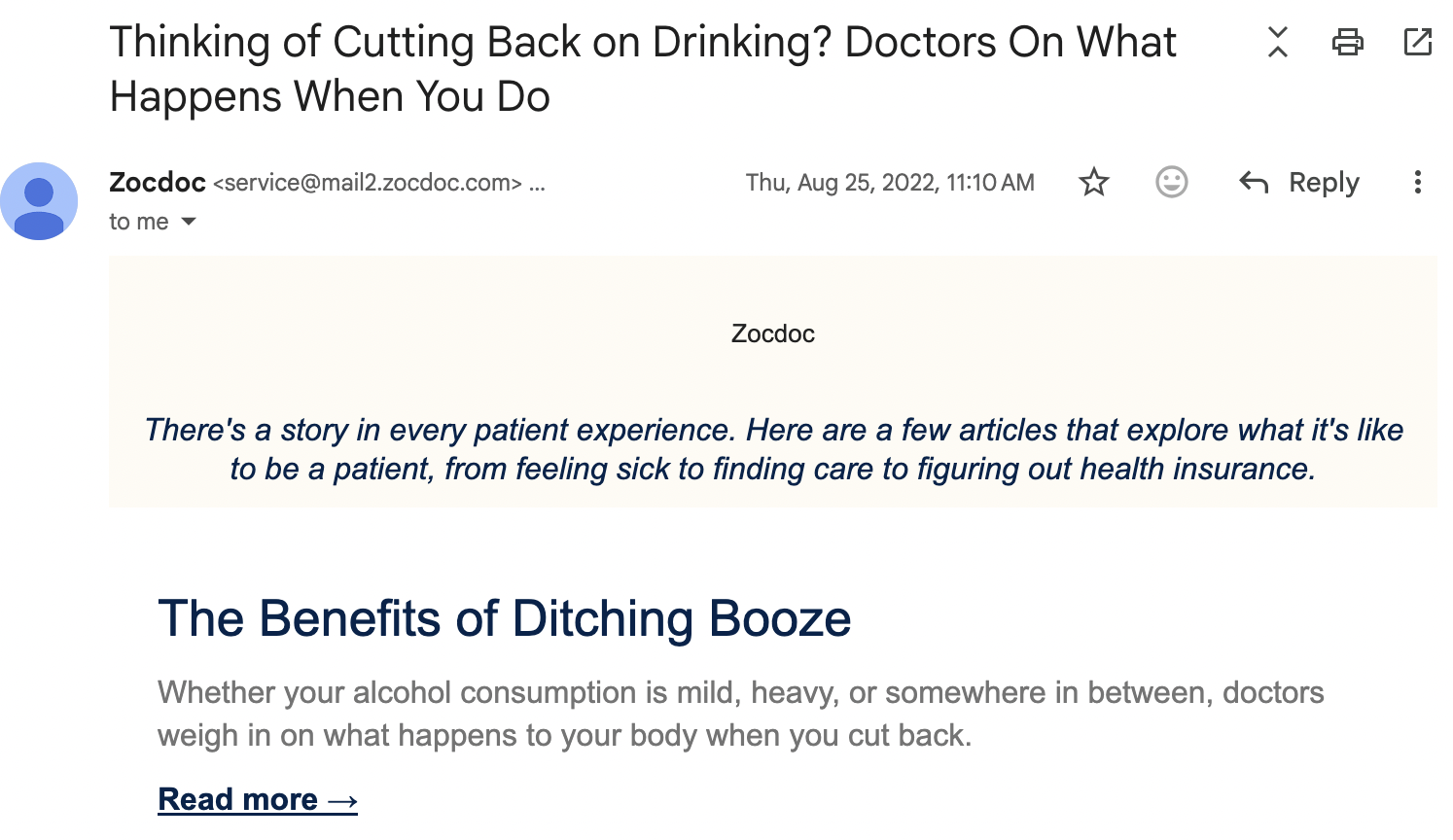
I got this spam/email from ZocDoc the day I stopped drinking alcohol.

“Shoot, Zocdoc, maybe you’re right. Maybe this is it.” I browsed some of the popular quit-drinking books and one spoke to me, This Naked Mind by Annie Grace. It really clicked as I read the entire book that morning: I struggle with moderating alcohol because alcohol is addictive. There are all these profiting industries and social pressures that sustain people’s struggles with it. I don’t have to participate. I can just …stop.
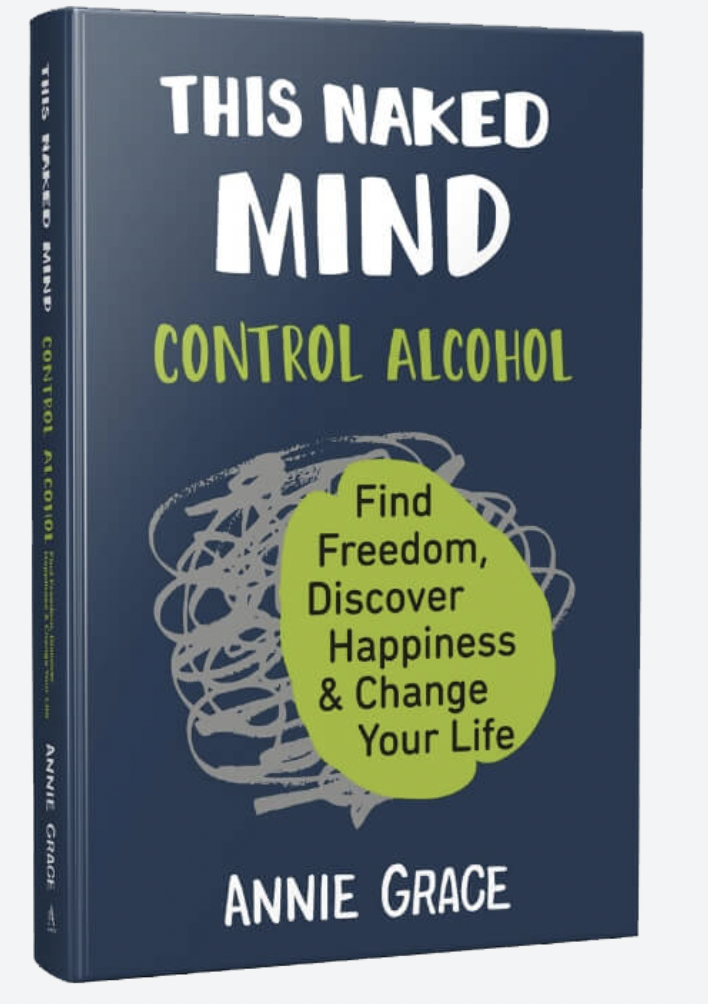
I read this book the day I stopped drinking alcohol.

It’s been four years since I had any alcohol, and it’s the best thing I’ve ever done for myself other than get married. (My loving wife chose to stop drinking with me out of support <3.)

I tried moderation for a long time and it took a lot of effort. Now that I have given it up, I don’t have to count drinks, or plan my week activities around where alcohol will or won’t be. I don’t have to try not to have more than two beers before halftime, or try to act sober after accidentally having five, or try to be extra patient with my kids on Saturday morning even though I feel like a piece of grumpy, soggy cardboard.

I got all of the conventional benefits from quitting—e.g., better parent, better husband, better sleep, better shape, better professional. The biggest pleasant surprise for me was getting my music back. Although I never stopped playing or writing music, I didn’t finish anything from roughly age 23 to 36. In the past four years I’ve published four solo albums and I am in a very cool band. Something had gotten stuck and right around when I quit drinking it got unstuck, and I am so grateful. In conclusion: after years of trying to be a responsible drinker, I gave up the ruse and got loads of relief and benefits in return.

On Inventing

Inventing new things is a gratifying part of my career; a list of some of my inventions, as USPTO granted patents, are pasted below. At work I get a lot of questions about how I patent so much. The short answer is 1.) I learned how to write in grad school, and I am more diligent than most people about actually writing down my inventions and submitting them to the patent lawyer; 2.) I intentionally carve out time to be open to inventing: I create a purposeful habit and put in the time; 3.) I try not to be too perfect and I try to be kind to myself when my “new” idea for the week ends up being a dud. Being knowledgeable about my field(s) is helpful to avoid reinventing the wheel, though if I invent something that already exists, I try to use it as positive feedback that my idea had merit.

A few books have influenced my approach on the topic:

FUNdaMENTALs of Design is a textbook that Professor Slocum used when he taught 2.007, the Mechanical Engineering design course. I had the good fortune of taking 2.007 with Alex, and also performing undergraduate research with him; he also oversaw parts of my master’s thesis work.

If you’re not prepared for it, it can be exhausting and intimidating to work with someone who is so full of ideas. But, if properly harnessed it is super inspiring and fun. One grad student in Prof Slocum’s lab once told me, “Alex has an interesting idea every hour, and my job is to figure out which ones are the really good ones.” I think Alex’s book does a great job of describing how to be open to new ideas while also being disciplined about when and how to act on those ideas.

Songwriter’s on songwriting interviews 50+ famous and successful songwriters. Some writers start with words; others start with melodies. Some do it in their heads; some write it down; others record snippets. Some write at 10am every morning, put in their 2 or 3 good hours and stop; others wait until late in the night and binge. One thing is for sure: all of them write a lot of songs. Even “one hit wonders”–those who only get known for writing one song–write a huge amount content.

Thomas Edison is famously quoted, “If you want to have a good idea, have alot of them.” The same is true for any creative endeavor: if you want to write a good song, write alot of them. If you want to invent, invent.

This video of The Police is a neat look into their songwriting process. In 1981, The Police were hugely successful giants, but they still faced the same struggles and process needs as any other creative person.

Bird by Bird is a charming text on famous author Anne Lamott’s approach to writing. I read it over and over again because it makes me feel courageous. I’ve adopted the index card habit from the book: I keep boxes and boxes of “ideas” and other plans, and when I’ve got spare time I open the box and see what I might push on next.

A recommended structure for technical presentations

The medium length (15 to 45 minute) technical presentation is an important communication medium used in both industry and academia. This post recommends a structure for technical presentations that emphasizes getting the most important points of the presentation out as soon as possible. A common but weaker approach is to develop a linear narrative that builds to a final conclusion, which is nominally the most important information of the presentation.

The two approaches are contrasted in the figure below[1]. In these figures the x-axis is presentation time and the y-axis is information value delivered during the presentation. The top figure describes the linear narrative approach, in which the key insight is not delivered until the final moments of the presentation. The bottom figure shows the superior structure, which immediately emphasizes the most important information. This approach can benefit both the speaker’s preparation and audience members’ ability to attain and digest information.

informationAndTime

The recommended presentation structure seeks to address the most important and interesting information as soon as possible. For example, if your research resulted in building something, show the thing you built as soon as possible. If your research resulted in useful scientific insight, show the insight you developed as soon as possible. Once the cat is out of the bag, the remaining time can be spent focusing on information that bolsters and contextualizes the primary point of the talk. This allows for the presenter to react and respond to audience interest in an unplanned manner – the presenter does not need to stay on a tight script in order to “get to the point,” which enables a richer potential set of context dependent presentations. Similarly, members of the audience struggle less to “figure out the point,” and are more likely to come away from the presentation with something useful if they doze off at some point.

In contrast, in the linear narrative structure the bulk of the presentation time is spent building up a story and “saving” the most important information of the talk for a big finish. At first glance it may seem sensible to arrange a presentation in the order in which work was performed, ending with triumphant completion. For example, a project may have begun with a problem and subsequent hypothesis. Then, an experimental procedure was designed and implemented and the results were analyzed. The results were compared to the hypothesis, and 27 minutes into the 30 minute presentation, the big finish – the exclamation point! – arrives: a scientific conclusion was reached. Additional important information is revealed in the 29th minutes: there is new insight into what scientists may do now. Alternatively, time runs out and we get a rushed conclusion and don’t get to hear about the implications and context of the work ☹.[2]

There may be a time and place for a linear-narrative presentation, but in the context of technical presentations the structure is likely only suitable for a few projects or audiences. This brings up an important wrinkle: the optimal presentation structure should be dictated by the context of the presentation and the needs of the audience. In technical settings, placing early emphasis on important information addresses many common needs of an audience: audience members need some tangible thing to hold onto in order to efficiently filter and categorize the myriad technical details that may be stated or implied during a presentation. Furthermore, they need some tangible reason to justify struggling to spend the next 30 minutes grappling with your particular technical details.

Even gracious audience members may also need a tangible reason to justify why they came halfway across the world (!) to see you talk. This justification leads to my favorite sentence structure for developing and refining the key message of my own presentations: I practice opening my presentation with increasingly ambitious sentences, such as –

• “The reason I’m keeping you in the office an extra hour this afternoon is to show you my cool new thing…”

• “I came to Hong Kong today because I wanted to share my cool new thing…”

• “Thanks for coming to meet me today to consider giving me $10 billion because you think it could be a great investment. Let me show you my cool thing…”


[1] Prof David Trumper sketched this image while providing me useful critical presentation feedback.

[2] The linear-narrative becomes particularly intractable when describing work in which much of the engineering/scientific steps were performed iteratively.